(1) The following graph represents a motorcycle ride.
(i) Mark the point(s) on the graph that shows the motorcycle is at rest.
(ii) Mark the point(s) on the graph that shows motorcycle with constant velocity.
(iii) Complete the table given below based on the graph.
Time
(sec)
Speed
(m/s)
0
1
2
3
4
5
6
7
8
9
10
11
12
(2) Police control room receives an information that a black suspicious car is going to pass, please stop it and check it. At 12’o clock the car moves past the front of the station. The police start their patrolling jeep exactly at 12’o clock but for 2 minutes they could not move the jeep due to some engine issues. Please answer:
(i) If the car is moving still why the line is running parallel to the x axis horizontally?
(ii) Please draw the first 2 minutes of the police jeep when it was not able to move. Draw the line on this graph.
(3) Look at the graph and answer the following:
(i) Please identify which train is in motion and which is at rest.
(ii) Tell us how these graphs are different.
(4) Use the data given in the table below to plot the graph of two objects moving with different velocities.
Time
(sec)
Object 1
Speed (m/s)
Object 2
Speed (m/s)
0
0
0
1
2
1
2
4
2
3
6
3
4
8
4
5
10
5
6
12
6
(5) Look at these graphs – do they represent same kind of motion? How do they defer from each other?
Problem:
Look at the velocity-time graph of a moving object. The area enclosed by the velocity-time curve and time axis gives you the total distance covered by the moving object. You will learn this in the equation of motion. Please fill up the blanks to get the distance for the graph given below.
Area of a triangle = ½ x a x b
= ½ x......x.......
= 36 unit
You will use this method to find the distance in section on equation of motion, where you will learn how to relate four quantities to get equations to work out complex problems of motion.
[Contributed by administrator on 10. Januar 2018 21:46:54]
Let's do exercises
(1) The following graph represents a motorcycle ride.
(i) Mark the point(s) on the graph that shows the motorcycle is at rest.
(ii) Mark the point(s) on the graph that shows motorcycle with constant velocity.
(iii) Complete the table given below based on the graph.
Time
(sec)
Speed
(m/s)
0
1
2
3
4
5
6
7
8
9
10
11
12
(2) Police control room receives an information that a black suspicious car is going to pass, please stop it and check it. At 12’o clock the car moves past the front of the station. The police start their patrolling jeep exactly at 12’o clock but for 2 minutes they could not move the jeep due to some engine issues. Please answer:
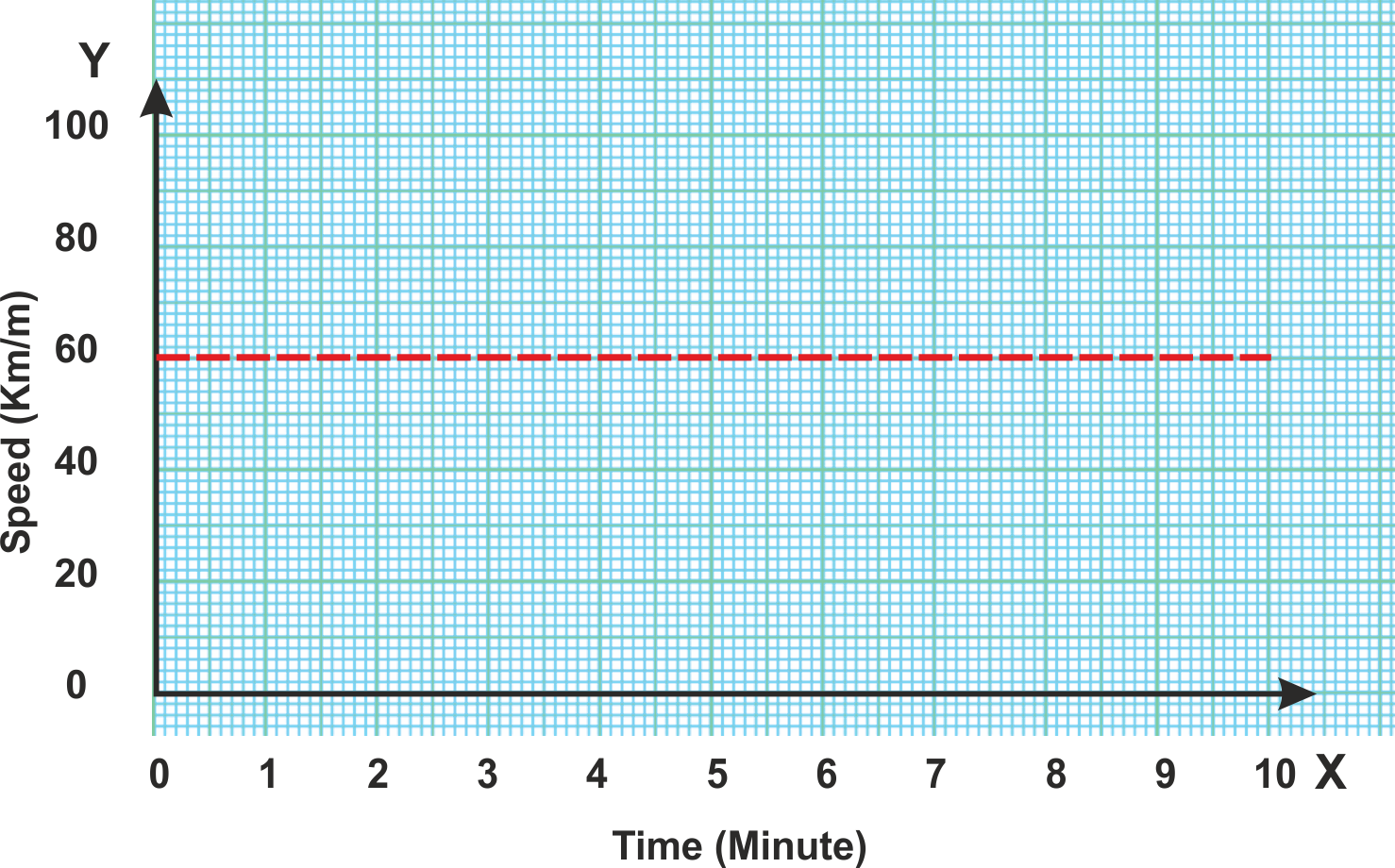
(i) If the car is moving still why the line is running parallel to the x axis horizontally?
(ii) Please draw the first 2 minutes of the police jeep when it was not able to move. Draw the line on this graph.
(3) Look at the graph and answer the following:
(i) Please identify which train is in motion and which is at rest.
(ii) Tell us how these graphs are different.
(4) Use the data given in the table below to plot the graph of two objects moving with different velocities.
Time
(sec)
Object 1
Speed (m/s)
Object 2
Speed (m/s)
0
0
0
1
2
1
2
4
2
3
6
3
4
8
4
5
10
5
6
12
6
(5) Look at these graphs – do they represent same kind of motion? How do they defer from each other?
Problem:
Look at the velocity-time graph of a moving object.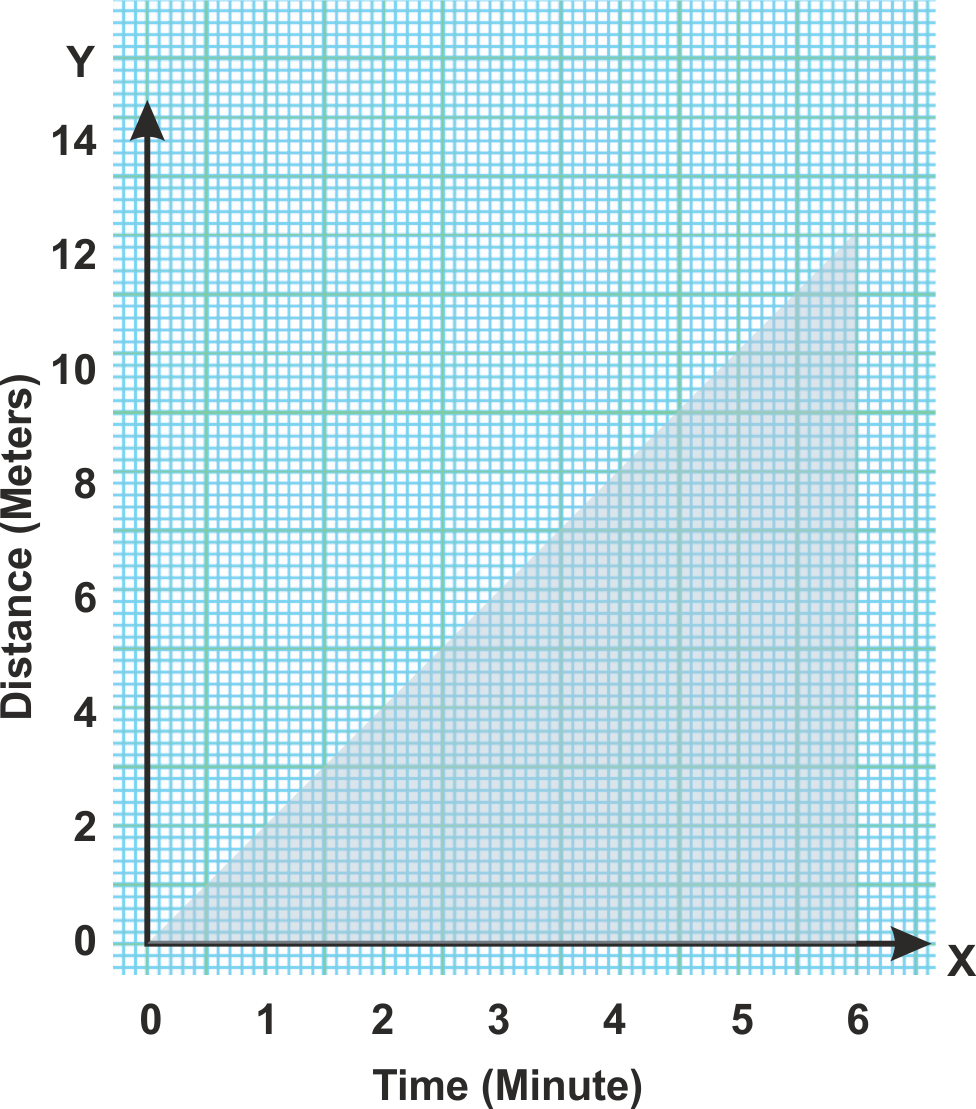
The area enclosed by the velocity-time curve and time axis gives you the total distance covered by the moving object. You will learn this in the equation of motion. Please fill up the blanks to get the distance for the graph given below.
Area of a triangle = ½ x a x b
= ½ x......x.......
= 36 unit
You will use this method to find the distance in section on equation of motion, where you will learn how to relate four quantities to get equations to work out complex problems of motion.